
 kirkusreviews.com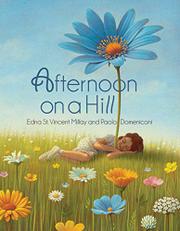
A poem by Edna St. Vincent Millay
gets an illustrated treatment.
The 12 lines of Millay’s 1917 poem provide
the whole text for this glorious nature outing. “I will be the gladdest thing /
Under the sun!” opens the adventure, as the anonymous first-person narrator
runs over grassy hills wearing a short-sleeved calico dress and sneakers. The
poem can be read literally as realism, but in the illustrations, a fantasy
realm grows. When the lines say “I will touch a hundred flowers / And not pick
one,” a single flower grows to the scale of a sapling. The heads of massive
birds peer out from between trees, their eyes intense and just this side of
ominous. A forest, from a long view, is shaped like an animal, absorbing (not
reflecting) sunlight even while the narrator’s peachy skin glows with reflected
sun. When the poem lets the protagonist “[w]atch the wind bow down the grass, /
And the grass rise,” the grass becomes a horizontally billowing ocean for the
child to windsurf on, standing upright on an enormous leaf, arms outstretched,
hair streaming. The illustrations are all full-bleed spreads; each has a
different light. Domeniconi offsets acute, scientific-feeling, almost
overpowering visual details on flowers and birds against vague, generic skies and
distant trees. At dusk, lights glow in the distant town, and the narrator beds
down—nestled in the antlers of a mighty animal, possibly an elk.
Romantic and bracing. (Picture
book. 4-9)






Add comment