
 kirkusreviews.com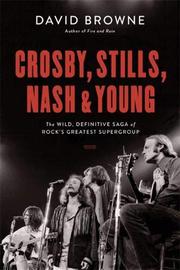
A warts-and-all—mostly warts—look at the legendary musical
group.
Judging by Rolling Stone contributing editor
Browne’s (So Many Roads: The Life and Times of the Grateful Dead, 2015,
etc.) latest book, it’s altogether improbable that all four members of Crosby,
Stills, Nash & Young should still be alive and perhaps even more improbable
that they smoothed out their feuds and egomania enough to record together for
so long. The story begins with David Crosby and Stephen Stills plotting to lure
Graham Nash from the Hollies. Characteristically, the three can’t agree on
where they first sang together, but it appears to have been a Hollywood street
outside a club where the British band was playing in February 1968. Stills
emerges in these pages as a stern taskmaster given to running the trio—and,
intermittently, quartet, with the addition of fellow Buffalo Springfield alum
Neil Young—as a military outfit, staying up with chemical help for days at a
time to get exactly the right sound down on tape. For his part, Nash often
figures as peacemaker and go-between, although Browne makes it clear that the
peace-and-love avatar has both an ego and a temper. Throw the
head-in-the-clouds Crosby into the mix, and it’s a perfect recipe for
volatility—and magic. The author appears to have talked to nearly every living
soul with a part to play in the band’s long career, except for Stills and
Young, who disagreed on nearly everything about the group but came together in
keeping mum. Says Crosby, meaningfully, “We had a good band. It was easy. I
made a good paycheck. But we had gotten to the point where we really didn’t
like each other.” Though the narrative takes some of the bloom off the Flower
Power rose, it also celebrates those fine moments when the band merged to make
such epochal songs as “Suite: Judy Blue Eyes” and “Ohio.”
Fans of CSN(Y) may find this disenchanting, but Browne delivers
an excellent portrait of a troubled partnership.





Add comment