
 kirkusreviews.com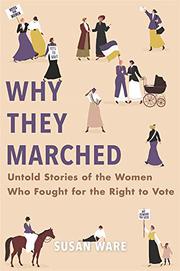
A collection of inspiring stories of the women who fought for
the 19th Amendment.
Refreshingly, Ware (American Women’s History: A Very Short
Introduction, 2015, etc.), the honorary women’s suffrage centennial
historian at the Schlesinger Library, focuses on many of the lesser-known but
equally audacious, talented women who joined the fight, profiling 19 courageous
individuals who thought for themselves and brought their husbands willingly
with them. “To bring the story of the…movement to life,” writes the author, “I
have organized the narrative as a prosopography featuring nineteen discrete but
overlapping biographical stories.” Many suffragists were abolitionists first,
which both strengthened and weakened their cause, as the same arguments against
granting votes for black men were applied to women. The feminist movement
merged with the suffragists in the early 1900s, and feminism brought a broader
commitment to economic independence, sexual emancipation, and freedom from the
need to marry. Individual states began to give women the vote slowly, beginning
with Utah in 1870, although it was temporarily repealed in 1887 in an attempt
to control polygamous marriage. By 1896, Colorado, Wyoming, and Idaho had given
women the vote. Those who fought for enfranchisement were often writers,
artists, and cartoonists, and their work was put to good use in designs for
banners, buttons, and posters and in publications like Alice Stone
Blackwell’s Woman’s Journal and Charlotte Perkins
Gilman’s Forerunner. There were also those who were
practically a one-woman show—e.g., Claiborne Catlin, who raised awareness in
Massachusetts during her long unfunded pilgrimage on horseback. Ware also
discusses the experiences of black women, like Ida B. Wells and Sojourner
Truth, who faced not only sexism, but racism as well. Mary Church Terrell, the
daughter of wealthy ex-slaves, not only traveled to Europe, but also addressed
the Berlin International Council of Women in 1904. By 1919, most of the Western
states had granted women the vote; the next fight would take all their talents
to gain ratification of the amendment.
Important American history that is also timely given recent
attempts at voter suppression.




Add comment