
 kirkusreviews.com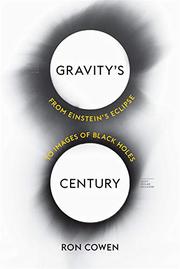
A brief history of the past 100 years of experimentation related
to Einstein’s theory of relativity, black holes, and more.
The 100th anniversary of the 1919 eclipse photographs that
showed the sun’s gravity bending light waves and made Einstein a superstar has
not gone unnoticed, so readers seeking a primer on relativity can choose from a
rush of popular books, which includes this slim, earnest account. What’s
relative in relativity is motion, explains science writer Cowen. No matter how
an observer moves, the laws of physics and speed of light never change. This
sounds trivial, but the consequences are bizarre. In his 1905 discovery of
special relativity, Einstein proved that time passes more slowly and objects
grow heavier as they move faster. Time would stop and an object’s weight become
infinite at the speed of light, so this is an unreachable limit. Special
relativity is easy; only high school math is required, but it only applies to
steady motion. Einstein’s general relativity theory of 1915 explained all
motion, which includes acceleration and gravity. This formulation turned out to
be wildly difficult. The math was so complicated that Einstein needed a
mathematician friend’s help. Cowen delivers a solid history of relativity’s
past 100 years. He works diligently and sometimes successfully to describe
concepts such as curved space, black holes, gravitational waves, and dark
energy. Most popular accounts admit that relativity explains the macroscopic
universe but fails at the atomic level, which follows laws of the century’s
other great breakthrough in physics: quantum mechanics. Physicists are working
hard to reconcile the two theories; none of many ingenious hypotheses have
stood up, and Cowen’s imaginative efforts to explain them are only partially
successful—but this is not an area where popular writers excel.
A fine introduction to the basics—if not the complexities—of
relativity.




Add comment