
 kirkusreviews.com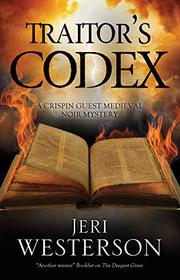
Religion and politics prove to be a volatile combination for
Crispin Guest.
London, 1394. Guest, disgraced knight and clever detective—a man
lucky to escape with his life, though not his property or station, when he
backed the Duke of Lancaster, in whose home he was raised, to become king over
his nephew, the volatile Richard II—has been making ends meet by taking on any
case that promises payment. Sitting in his favorite tavern, he’s approached by
a man who gives him a book and says that he’ll know what to do with it. The
leather-bound book is obviously very old, but Crispin can’t read its language,
so he and his longtime apprentice, Jack Tucker, who shares Crispin’s small
house along with his wife and children, go to a book dealer who tells him it’s
a papyrus written in Coptic. His next stop is a goldsmith, who suggests he try
the barber surgeon Peter Pardeu, a learned rabbi who’s stayed hidden in England
since the expulsion of the Jews. Pardeu identifies the codex as the gospel of
Judas, one of several rejected by the Council of Nicaea. Crispin knows the
volume is dangerous but can’t bring himself to destroy it. While he’s still
pondering his options, he literally runs into Lancaster, who takes him to the
palace to make sure the queen’s death was not murder. Meantime, all the men
he’s consulted about the book are killed and Crispin himself is attacked
several times. When Richard discovers him in the palace, their conversation, a
revelation to Crispin, leaves him in greater favor with the king but still a
traitor. Back in London, he must escape those who want the codex and deal with
an imposter using his name while trying to solve three murders.
Fans of this long-running series (The Deepest Grave,
2018, etc.) will revel in the insights into their favorite characters’ lives
while enjoying the historical background and a challenging mystery.






Add comment