
 kirkusreviews.com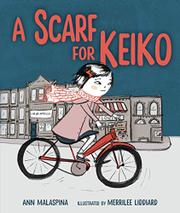
An act of kindness during World War
II still resonates today as a boy reaches out to a girl whom the government
does not consider a suitable or loyal American citizen.
The United States has entered World
War II, and Sam’s class in Los Angeles is knitting socks for soldiers.
Unfortunately, Sam cannot get his knitting needles to work properly as he tries
to knit for his older brother, who is fighting overseas. Frustrated, he rejects
an offer of help from his neighbor and classmate, Keiko, a girl of Japanese
descent. Keiko is taunted and her father’s flower store is vandalized, and then
the family is sent to an internment camp. Sam and his parents are sympathetic—as
Jews they understand persecution—and his mother offers to keep safe Keiko’s
mother’s treasured tea service. When Keiko leaves her bike with Sam, she includes
knitted socks for Sam’s brother. It is then—finally—that Sam comes up with a
most neighborly gesture: He will knit a scarf for Keiko because desert nights
can be cold. Carefully, stitch by stitch, he finishes his project. The
illustrations, in browns, greys, and reds, focus on the faces of the characters
and express their frustrations, fears, and concerns. The author’s note briefly
explains both President Roosevelt’s 1942 Executive Order and the 1988 Civil
Liberties Act.
A gentle and accessible story of
tolerance during a war overflowing with racial and ethnic intolerance. (author’s note, photographs) (Picture
book. 5-8)




Add comment