
 kirkusreviews.com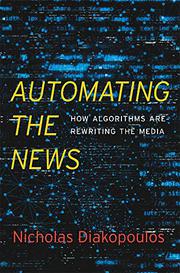
Can machines take over the job of human reporters? Increasingly,
they’re doing just that.
Machines are already hard at work putting together the morning
paper or news broadcast, writes Diakopoulos, the director of Northwestern’s
Computational Journalism Lab. At the Associated Press, for example, “every
fiscal quarter automated writing algorithms dutifully churn out thousands of
corporate earnings articles.” Such articles were the stuff of drudge work once
assigned to cub reporters, but now machines can parse corporate reports,
extract the required information, and put it into readable form. By the
author’s account, this is a positive development; it allows news organizations
to publish quickly, and it gives seasoned human journalists the raw material to
dig in and do data-rich interpretive work. Just so, he notes, at least a
quarter of all Bloomberg News reports are done by computers in whole or part.
Algorithms, he writes, “are suffusing the entire news production chain.”
Sometimes they weigh whether one headline is more effective (and clickworthy)
than another, and other times they data mine to support investigative
reporting, sorting through vast bodies of material to dig out the ones that are
truly relevant to a case and, of particular interest, “claim-spotting” with
computational tools as an aid to fact-checking. Diakopoulos counsels that this
algorithmic wealth will be put to work in situations that are subsidiary to
human journalism. Though one wonders whether the bosses might not like machines
that can replace human editors, the author argues that these modern machines
belong in the realm of telephones, cameras, and other technological adjuncts to
journalism that have come along in the past, for the work of reporting and
writing is really itself the realm of human creativity. “Rare is the algorithm
that can surprise and delight in entirely unanticipated ways,” he writes—rare,
but not entirely out of the question, for which reason he urges news
organizations to get busy developing “their own competitive strains of
algorithms and AI for knowledge production.”
Despite all the troubling possibilities, Diakopoulos predicts a
thriving future for machine algorithms. A useful book for newsrooms and
journalism students.




Add comment