
 kirkusreviews.com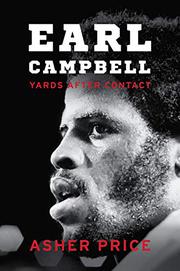
Thoughtful portrait of the 1977 Heisman Trophy Winner and 1991
inductee into the Pro Football Hall of Fame.
Earl Campbell (b. 1955), writes Austin American-Statesman reporter
Price (Year of the Dunk: A Modest Defiance of Gravity, 2015, etc.), was
a force of nature on the field, “a modern John Henry, the heroic and tragic
figure of a hard-working, plow-straight-ahead man who worked himself into a
broken-down condition by giving it his all—his body an atlas of the brutality
of the game.” Born in small-town Texas, Campbell always had “country manners”
that led some to think of him as a bumpkin, which he answered with a stiff arm
and phenomenal moves on the field that led many students of the game to
consider him one of the greatest players ever. Campbell was a fearsome player
who graced the campus of the University of Texas, once a bastion of
segregation, at a time when Austin was emerging as a perhaps unlikely capital
of hippiedom. Price’s portrait of a town where “on game days in the parking lot
of Mother Earth, a club not far from campus, you could barter football tickets
for weed” is nicely detailed, and it’s telling that as part of his rookie
hazing on the roster of the Houston Oilers, Campbell sang “Mamas, Don’t Let
Your Babies Grow up To Be Cowboys.” Price knows his sports, and he writes well
about such things as the Landry Shift—“a beat after taking their stance…the
offensive linemen, in unison, would stand and reset”—and Campbell’s
considerable skills as a running back. More than that, he discusses Campbell’s
college and pro careers against the backdrop of racism that accompanied the
“shift from crew cuts to Afros” of which he was a part, considering himself to
be a champion of racial reconciliation who had the outward demeanor of a
“smiling athlete” but was altogether serious.
A well-crafted life of a man who, though now largely out of the
spotlight, enjoyed a storied career.




Add comment