
 kirkusreviews.com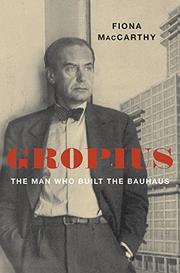
A fresh biography of the influential modernist architect who
shaped aesthetics from the 1920s to our own time.
Award-winning biographer and design and architecture critic MacCarthy
(The Last Pre-Raphaelite: Edward Burne-Jones and the Victorian
Imagination, 2011, etc.) brings insight and sensitivity to a sweeping,
penetrating life of Walter Gropius (1883-1969), founder of the Bauhaus, an
experimental community of architects, sculptors, painters, and craftsmen.
Established in Weimar in 1919, the Bauhaus, in its early years, was devoted to
craft, owing “so very much,” Gropius admitted, to William Morris’ Arts and
Crafts movement. Soon, influenced by Constructivist László Moholy-Nagy, who
joined the community as a teacher, Gropius changed the emphasis “from the
handmade and romantic to the clean-cut and mechanistic,” leading to a
“smooth-lined, restrained, subtly geometric” design that became emblematic of
Bauhaus style in architecture, furniture, and art. The school attracted
brilliant artists as teachers, including Paul Klee, Vasily Kandinsky, Josef
Albers, and Marcel Breuer. But there was often conflict among them and, after
the Bauhaus moved to Dessau, between the community and “less enlightened
members” of the public. Money was a perennial problem, as well; in 1928,
Gropius resigned and moved to Berlin, where he aligned himself with a radical
group of architects who hoped to go beyond “the design of individual buildings
into the economic planning of whole cities.” By 1932, however, architectural
innovations faced Nazi artistic censorship, and Gropius was vilified. MacCarthy
follows Gropius’ career in Britain and the U.S. after he left Germany in 1935
and, a few years later, became chair of the Department of Architecture at
Harvard’s Graduate School of Design, where his students included such eminent
architects as I.M. Pei and Philip Johnson. Besides following Gropius’
professional life, the author vibrantly portrays his love affairs, marriages
(notably to the turbulent Alma Mahler), the death of his beloved daughter, and
his close, sometimes-strained friendships. Altogether, she produces a
multidimensional portrait of a towering, complex figure whose ideas, one
historian remarked, “reshaped the world.”
Engrossing, impressively researched, and keenly perceptive.






Add comment