
 kirkusreviews.com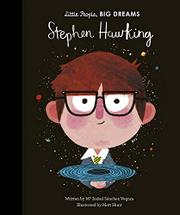
A first introduction to
the greatest scientist of the past half-century.
Hawking makes a worthy
but not an easy subject for an elementary-grade profile, as the likelihood that
younger audiences aren’t really up on the ins and outs of quantum theory or
gravitational singularities limits the author’s tally of his scientific
contributions to a mention (sans meaningful context) of “Hawking radiation.”
His other claim to fame, as an exemplar of the triumph of mind over physical
disability, is far easier to grasp. For this, Hunt’s cartoon-style
illustrations of a smiling scientist with idealized features on an oversized
head help reinforce the notion that, as Hawking put it, “However difficult life may seem, there is always something that you can do and succeed
at.” He leans on a cane before a wall of mathematical notations, takes his
children for a spin on his wheelchair, and lectures to a rapt audience. The
author (or an uncredited translator) uses some inept phrasing—a bald
observation that eventually he “lost his voice and found a new one with a
robotic drawl” can only leave readers confused, for instance. Illustrations of
crowds place the white scientist among diverse gatherings. A closing note offers
photos and a bit more detail plus a trio of titles for older readers.
A timely if unpolished
entry in the Little People, BIG DREAMS series. (Picture book/biography. 5-7)





Add comment