
 kirkusreviews.com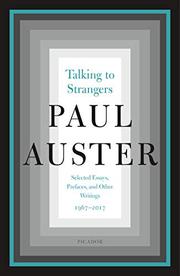
An eclectic collection of essays from the 50-year career of
a beloved novelist and thinker.
In the first piece, Auster (4 3 2 1, 2017, etc.)
muses that “to feel estranged from language is to lose your own body. When
words fail you, you dissolve into an image of nothingness. You disappear.”
One can forgive him for a bit of youthful melodrama, as the essay was written
in 1967, when the author was only 20 years old and his illustrious literary
career still years away. Still, it’s a start to the collection, which skips
through that career at a chipper pace, highlighting some of his famous essays
and criticism along with several pieces that have never been published.
Selections from the 1970s are particularly erudite; Auster was then a young
poet and little-known novelist, but he made a name for himself contributing
pieces of literary criticism to the New York Review of Books.
Beckett and Kafka—two writers with undeniable influences on Auster’s own
fiction—appear for the first time there and then several more times throughout
the book. One of the most engaging essays is also one that another writer or
editor might have shoved, forgotten, in a drawer: a lecture from 1982 at Seton
Hall that becomes a fascinating exploration of the influence of European
readership on Edgar Allan Poe, which is particularly interesting considering
how popular Auster would become in Europe. Later in the collection, the essays
branch out from literature to other art forms, as Auster writes about filmmaker
Jim Jarmusch, illustrator Joe Brainard, and even New York Mets pitcher Terry
Leach. They also turn more personal, with the author examining everything from
an ode to his beloved typewriter (which Auster traveled with for decades even
as the world turned to computers and word processing) to a somber remembrance
of his family’s experiences during 9/11.
This isn’t essential Auster, but fans and scholars of his
work will undoubtedly be charmed and intrigued by his evolving thoughts on art,
language, and other assorted topics.



Add comment