
 kirkusreviews.com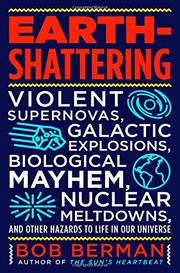
The universe is a weird, warped, violent place. And that’s the
good news.
Life is hard, and it’ll be harder still when Andromeda goes
sliding into the Milky Way in an inevitable collision of galaxies, even if
“colliding galaxies are mostly smoke and mirrors.” Fortunately, writes science
writer and Astronomy columnist Berman (Zapped: From
Infrared to X-rays, the Curious History of Invisible Light, 2017, etc.),
this won’t happen for “sometime sooner than four billion years from now.” From
the point of view of Earth, if there is an Earth, it’ll just be a sort of weird
warping of space and time. Cataclysm is the universe’s constant; as the author
writes, it’s a “a bumper-car ride” out there, but more than that, it’s a place
where the collision of worlds produces startling effects. One example is our moon,
which, by the increasingly regnant theory today, was born when a Mars-size
planet with oxygen smacked into Earth, blowing a chunk out to become a
satellite of our home. Against this backdrop, the current wave of mass
extinctions of life on Earth has many precedents in our planet’s history, which
doesn’t make it any more palatable. Berman writes with verve and vigor about
such things as the Snowball/Slushball catastrophe, the Cambrian explosion, the
meteor collision that produced the Chicxulub Crater (“giant tsunamis the height
of sixty-story buildings spread across the Caribbean”), novas and
supernovas and H-bomb tests, and all manner of suchlike terrors. Sometimes the
prose can get cutesy, in the catchy way of pop-magazine writing: “And although
the jury may be out on the success of the Big Bang…we members of Homo
bewilderus can shrug it all off with a ‘Don’t blame me, I wasn’t even
there’ innocence.” But mostly, Berman’s book is a pleasing excursion into the
hows and whys of how the universe—our universe, anyway—took shape and how it
works—except when it doesn’t.
Just the book for a bright teenager interested in astronomy and
geosciences.




Add comment