
 kirkusreviews.com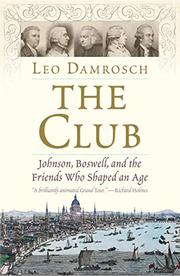
Memorable portraits of members of a London club who met weekly
to discuss literature, politics, and life.
From 1764 to 1784, a group of men met once a week in a private
room at the Turk’s Head Tavern in London for conversation and, in varying
degrees, camaraderie. They called themselves, simply, “The Club,” and they included
some of the most prominent personalities of the time, including Edward Gibbon,
Adam Smith, Joshua Reynolds, Edmund Burke, David Garrick, Oliver Goldsmith,
Richard Sheridan, and, most significantly, Samuel Johnson and his acutely
observant biographer James Boswell, who take center stage in this masterful
collective biography. Like Jenny Uglow did in The Lunar Men (2002),
Damrosch (English/Harvard Univ.; Eternity’s Sunrise: The Imaginative
World of William Blake, 2015, etc.) offers incisive portraits of individual
members, highlighting their relationships and interactions with one another to
reveal “the teeming, noisy, contradictory, and often violent world” they
inhabited. It was a world confronting upheaval: noisy agitation in Britain’s
American Colonies, bloody rebellion in France, debate over slavery, and
domestic economic stress. Between 1739 and 1783, Damrosch notes, Britain was at
war for 24 years, at peace for 20. In 1776, Adam Smith’s The Wealth of
Nations and Edward Gibbon’s The History of the Decline
and Fall of the Roman Empire both spoke to national preoccupations:
Smith, to inequality and the consequences of industrialization; Gibbon, to
fears about maintaining the empire. Besides illuminating the salient issues of
the day, Damrosch characterizes with sharp insight his many protagonists:
abstemious Johnson, who likely would be diagnosed with depression and
obsessive-compulsive disorder today; womanizing, hard-drinking Boswell, an
unsuccessful lawyer with “unquenchable confidence,” intelligent, but “no
intellectual,” whose mood swings indicate that he may have been bipolar.
Although Damrosch emphasizes the men and their works, he does not neglect the
women in their lives: memoirist Hester Thrale, for one, who offered Johnson
“crucial emotional support” as his confidante and therapist and novelist and
diarist Fanny Burney.
Late-18th-century Britain comes brilliantly alive in a vibrant
intellectual history.





Add comment