
 kirkusreviews.com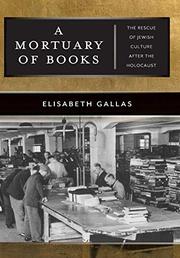
Saving cultural property was central to postwar Jewish identity
and recognition.
Throughout World War II, Jewish leaders around the world became
horrified that Nazi looting of books, manuscripts, Torah scrolls, ritual
objects, and documents would annihilate Jewish culture in Germany and Eastern
Europe. In meticulous detail, drawing on archival sources, memoirs,
correspondence, and histories, Gallas, chief research associate at the Leibniz
Institute for Jewish History and Culture, makes an impressive book debut with a
comprehensive history of efforts to recover, identify, and restore artifacts of
Jewish culture and scholarship. The process was complex and sometimes
contentious, generating debates about how to define the “Jewish
collectivity”—as constituted through “the collective experience of persecution,”
religious affiliation, or by territorial boundaries; how to give legal
recognition to that collectivity; where European Jewries and their
sociocultural worlds could be revived; and where—and under whose
auspices—recovered property should be housed. Gallas focuses on four
individuals who took prominent roles in the efforts: political theorist Hannah
Arendt; rabbi and scholar Salo W. Baron, who held the first professorship of
Jewish studies at Columbia and came to believe that Jewish communities could
never be re-established in Europe; archivist and historian Lucy S. Dawidowicz,
the daughter of Polish immigrants; and philosopher Gershom Scholem, who
championed an Israeli state as the only home for Jewish culture. Offering
capsule biographies of these key figures and extended examination of their
efforts, Gallas notes that they “differed fundamentally in terms of their
generation, background, self-image, and political vision” but “regarded their
shared rescue mission as an existential duty.” All contributed actively to
Jewish Cultural Reconstruction, Inc., the most significant of many such
organizations devoted to compiling detailed data about the recovered material.
The result, writes the author, “was tantamount to the creation of an archive of
documentation and remembrance.” Their work was imbued with emotion: “The smell
of death,” Dawidowicz said, emanated from hundreds of thousands of books and
objects, “orphaned and homeless mute survivors of their murdered owners.”
A fresh, significant contribution to Jewish history.





Add comment