
 kirkusreviews.com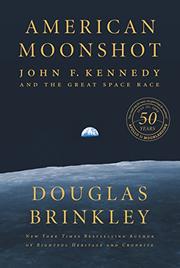
A look back at the days when American presidents and politicians
believed in and promoted science—days when there was a world to win, along with
the heavens.
Prolific historian Brinkley (Chair, History/Rice Univ.; Rightful
Heritage: Franklin D. Roosevelt and the Land of America, 2016, etc.) avers
that his latest is a contribution to “U.S. presidential history (not space
studies).” However, in his customarily thorough way, it’s clear that he’s
mastered a great deal of the facts and lore surrounding the Mercury, Gemini, and
Apollo projects that landed American astronauts on the moon 50 years ago. As
his account unfolds, two themes emerge. One is that fiscal conservatives,
exemplified by President Dwight Eisenhower, were reluctant to fuel the emerging
military-industrial complex, affording John F. Kennedy a campaign issue that
revolved around the “missile gap” between the U.S. and the Soviet Union. As
Brinkley writes, “having been raised in a family obsessed with winning at every
level, [Kennedy] reduced the complexities of Cold War statesmanship to a simple
contest.” The second theme is that the space race was very much an extension of
the wider Cold War. In both matters, notes the author, NASA became the
beneficiary of both federal largess and the advantages of “unfettered
capitalism,” tapping into a fast-growing network of military contractors and
spinning off basic research into an array of technological products. Even
during the Bay of Pigs crisis, Kennedy kept his eye on the lunar prize, tasking
his vice president, Lyndon B. Johnson, with determining whether the American
parties involved in the space race were “making maximum effort.” With JFK’s
assassination, the moon program seemed in danger of losing impetus and funding,
but thanks to a vigorous NASA administrator and political allies in Congress
and the executive branch, the Kennedy-inspired effort was realized. In fact,
writes the author, it became a “marvelous alternative to all-out war with the
USSR or future proxy wars such as Korea.”
A highly engaging history not just for space-race enthusiasts,
but also students of Cold War politics.




Add comment