
 kirkusreviews.com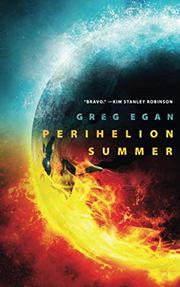
Near-future catastrophe devastates the Southern Hemisphere:
another entry from Egan (Phoresis, 2018, etc.) that’s more than a
novella yet less than a novel.
A small black hole, Taraxippus (taraxippoi were
horse-frightening demons believed to haunt racetracks throughout ancient
Greece), enters the solar system. Matt Fleming and his friends, concerned about
the possible effects of the black hole’s passage, invest in a mobile
aquaculture rig, the Mandjet, self-sustaining in food, power, and fresh water,
reasoning that they’ll be safe at sea no matter what climatic effects might
occur. Taraxippus, however, proves to be a double whammy: two black holes
orbiting one another. They don’t harm the planet directly but do pass close
enough to permanently perturb Earth’s elliptical orbit around the sun. Almost
immediately, Southern Hemisphere summers grow considerably hotter, with winters
much colder (the north experiences cooler summers and warmer winters),
rendering much of Australia and South America uninhabitable and accelerating
the melting of the Antarctic icecap. In a series of quick, vivid sketches, Egan
shows us how, for those aboard the Mandjet and their friends and relatives
still on land, life—the entire planet—will change forever. As a metaphor
representing global climate change, it’s effective enough; more than 30 years
ago, another Australian, George Turner, did something comparable in Drowning
Towers. This lacks that book’s weight and complexity, though it’s certainly
a noteworthy contribution to a debate whose implications Egan is content to
leave to our imaginations.
More an appetizer than an entree.





Add comment