
 kirkusreviews.com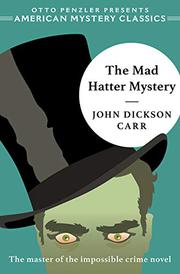
Dr. Gideon Fell, that beloved, avuncular detective from the
genre’s golden age, returns in this reprint of his second case, originally
published in 1933.
Otto Penzler’s brief introduction, which emphasizes Carr’s
unrivaled reputation nearly 50 years after his death as the master of the
locked-room mystery, hails this one for including “an impossible crime.” The
murder here doesn’t involve a locked room; instead, it pushes whimsical
absurdities to a sinister extreme. As the tale begins, Dr. Fell, just arrived
in London, hears of two notable thefts: the disappearance of an original Poe
story from the possession of Sir William Bitton, who’d unearthed it in one of
Poe’s homes in Philadelphia, and a rash of thefts of headgear—a police
constable’s helmet, a barrister’s wig, Sir William’s top hat—by some wag who
relocates his prizes to new places sure to offend the victims and amuse
everyone else. News swiftly follows that Sir William’s nephew, journalist
Philip Driscoll, who’s been milking the Mad Hatter story for all it’s worth,
has been found dead at Traitors’ Gate, in the densely fogged-up Tower of
London, stabbed or shot by a crossbolt Sir William’s brother and sister-in-law,
Lester and Laura Bitton, had recently brought home from a trip abroad. As usual
with Carr (The Hungry Goblin, 1972, etc.), the plotting is denser than a
London particular. But this time there’s nothing impossible about the mystery,
just plenty of outré details. In truth, this is middling Carr, unable to
sustain its atmosphere through the increasingly labored revelations of its
second half, and its principal red herring, the theft of all those hats, is
more vivid, more baffling, and more logically satisfying in its elucidation
than the murder of Philip Driscoll—a flaw Carr duly corrected in the
masterpieces that followed: The Three Coffins, The Burning
Court, The Crooked Hinge, and, as Carter Dickson, The
Judas Window.
Even so, fans won’t, and shouldn’t, hesitate to dive back into a
past in which whodunits could be so unsettlingly evocative in their setups and
so unabashedly brainy in their solutions.



Add comment